When a person collapses in front of you, the clock quits being abstract. You hear the superficial gasps, or you do not listen to breathing whatsoever. You really feel for a pulse and your hands are not as steady as you expected. That is the minute every glossy pamphlet concerning a first aid course is speaking about, yet it does not really feel like a sales brochure. It feels like a test.
I have trained people in first aid and CPR for enough time to see 2 patterns. Initially, practically everyone means well and intends to help. Second, numerous delay training because they assume it will take way too much time, be as well technical, or require a multi day commitment they can not manage.
Fast first aid courses and express CPR training are a reaction to that reality. The great ones trim the fat without cutting out the abilities that in fact save lives. The poor ones seem like a hurried slideshow that supplies a first aid certificate however very little competence.
This guide has to do with telling those 2 apart, comprehending what you really need from first aid and CPR training, and how to get fast certification without brief transforming safety.
What "fast" actually means in first aid and CPR training
Different service providers quietly imply different points when they promote a fast first aid course or express CPR course. Occasionally "fast" is marketing language layered onto a conventional schedule. Other times, it genuinely reflects a compressed layout, blended understanding, or analysis only options.
In functional terms, fast first aid training generally appears like one of three models:

Fast CPR courses have a tendency to be even shorter. A focused express cpr course might run 60 to 90 mins personally, sometimes with pre understanding online. A fast cpr correspondence course can be under an hour for individuals that practice abilities commonly, like registered nurses or lifeguards.
None of this is immediately good or bad. What issues is what gets compromised to get rate. If practice time, responses, and realistic scenarios are gotten rid of, the moment you minimize the course might be lost in hesitation throughout an actual emergency.
What you need to actually find out in a fast first aid and CPR course
A fast style does not excuse missing out on foundations. Whether you select a requirement, fast, or express first aid course, the core capability ought to be recognisable.
Here is what a strong fast first aid and CPR course need to cover at minimum:
Risk analysis and scene security: Checking for dangers prior to you rush in. Airway, breathing, flow: Easy techniques to evaluate responsiveness, breathing, and pulse if applicable. CPR training: Effective upper body compressions, rescue breaths if included in your neighborhood guidelines, and use an AED. Bleeding control and shock: Straight stress, elevation when appropriate, and early acknowledgment of shock. Essential first aid: Choking, burns, cracks or suspected cracks, and allergic reactions, especially anaphylaxis and automobile injector use.Some fast first aid courses will certainly additionally consist of short insurance coverage of clinical problems like stroke, bronchial asthma, diabetes, and seizures. The deepness varies. In my experience, a fast first aid course that invests at the very least some time on stroke recognition and bronchial asthma is far more valuable than one that avoids straight from CPR to bandaging games.
For child care specialists, express childcare first aid training requires to add child certain material: infant CPR, choking in young children, fever administration, and child safe positioning. If you deal with children, a common fast first aid course is seldom sufficient. Search for an express child care first aid course or complete childcare course, even if it is a little longer.
Online, blended, and face to face: just how fast styles in fact work
Fast and express first aid courses usually shave time by modifying exactly how and where you discover. Comprehending the trade offs will certainly assist you choose the ideal format.
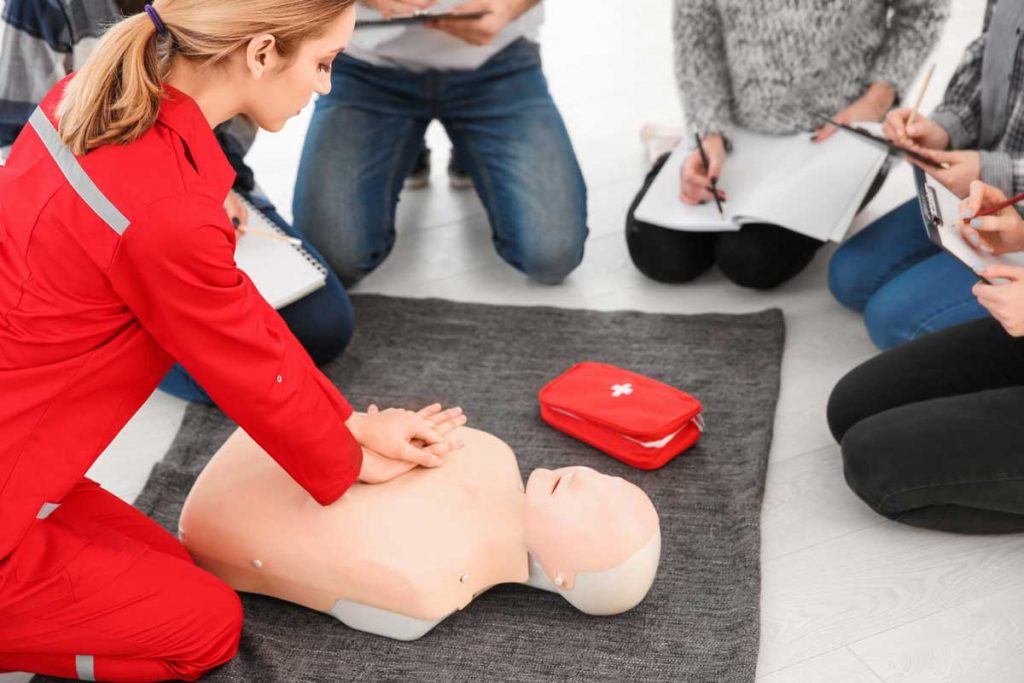
Fully in person fast first aid training compresses explanations and lowers repetition. A proficient instructor can do this without hurting top quality. The restriction is that the area still has a physical rate. 10 individuals sharing one manikin can not all compress at the same time. If the course is too brief, method goes down first.
Blended or express first aid courses relocate a lot of the theory online. You may watch video clips on CPR, read about bleeding control, and respond to tests before you enter a class. The in person component after that focuses on hands on skills, scenarios, and assessment.
Done well, combined knowing can be extra effective than a much longer traditional course. Learners arrive with basic knowledge and invest their time pressing, rolling, and improvising. Done poorly, it becomes a box ticking exercise where everyone skims modules the evening prior to and immediately forgets them.
Fully online CPR courses or first aid courses, without personally method at all, are where I see the most troubles. They are fine for standard awareness, and occasionally appropriate for low risk roles that only need academic understanding. However if you have never ever literally locked your hands on a chest, counted your compressions aloud, and really felt how much force is really required, you are not all set for real CPR.
For first aid and cpr training classes that result in a widely recognised first aid certificate, most authorities still call for some in person component. If a supplier supplies fast certification without hands on training, read the small print, especially if your employer, regulatory authority, or insurance firm has guidelines about approved first aid certificates.
How fast is as well fast?
Everyone desires efficiency. The question I ask when I examine fast first aid courses is easy: what would I anticipate a trainee to remember three months from now?
If the course is pared down so much that individuals barely touch a manikin or plaster, you see a pattern. They entrust to truths, not habits. They can tell you the compression to air flow ratio, yet their hands slide on the breast and they do not press deep enough.
As a rough criteria, for somebody without prior experience:
- A robust express cpr training session, with pre discovering, still requires a minimum of 45 minutes of real compressions, practice with an AED instructor, and feedback. A fast first aid course that consists of CPR, blood loss, shock, choking, and a handful of key conditions needs around 3 to 4 hours total, thinking excellent use on the internet modules.
Shorter than that and something is missing out on. Sometimes that is situations. In some cases it is individual assessment. In some cases it is the chance to ask those "suppose" concerns that make the difference between stiff textbook thinking and adaptive real life response.
That said, if you already have regular direct exposure to emergency situations, such as paramedics, security officers, or lifeguards, fast cpr refresher courses and short first aid refreshers can be extremely reliable. For these students, the objective is adjustment of drift and updates on guidelines, not educating from scratch.
Choosing a fast course service provider that does not cut corners
Not all fast first aid courses or express CPR courses are created equal. Price and proximity issue, but they are not the only elements. I have seen affordable, fast first aid training where the trainer mainly read slides, and I have actually seen well structured express first aid training that left people truly more prepared.
A brief checklist helps when you analyze companies:
Accreditation and recognition: Are their first aid and cpr courses aligned with acknowledged bodies or national guidelines in your country or region? Trainer experience: Are the instructors real practitioners or at least experienced fitness instructors with area direct exposure, not simply individuals checking out a script? Practice time: The amount of individuals per manikin or scenario? If it is more than 4 or 5 per manikin for CPR training, anticipate slim practice. Content clearness: Does the course rundown clearly point out CPR, bleeding control, choking, and AED usage, not just vague "emergency care" wording? Assessment standards: Does everybody obtain individually evaluated on CPR and crucial first aid abilities, or is the first aid certificate automatically released for attendance?If you are looking for a fast first aid course near me, make use of that expression as a beginning factor, then drill right into these details. A brief phone call to the service provider can reveal a lot. Ask how they deal with learners with no previous experience, for how long you will have your hands on a manikin, and whether there is any pre course work.
When a company can not answer those inquiries plainly, or seems inflamed by them, that is a signal.
What fast first aid resembles in real emergencies
I bear in mind a young friendliness supervisor that pertained to an evening express first aid course after a near miss at the workplace. One of his team had passed out in the amazing space. Nobody knew whether she was breathing properly, and they argued about whether to relocate her while waiting on first aid trainer certification a rescue. She recouped, but the manager knew just how not really prepared they were.
He could not spare team for a full day course, so he scheduled a fast first aid and cpr course: blended concept and a 3 hour useful. He took it seriously. By the time he strolled into the session, he had actually completed the online first aid training modules and created questions on a notepad.
Two months later, a customer had a cardiac arrest in the dining establishment. That manager started CPR before anybody else, asked a colleague to order the AED from the shopping mall corridor and had it connected within a number of minutes. The paramedics credited the early compressions and shock with giving the guy a battling chance.
He did not come to be a paramedic by going to an express first aid course. What he obtained was enough clarity to act rather than freeze. That is the practical objective of fast first aid: not mastery, however crucial capability in the initial essential minutes.
Balancing speed, depth, and your real risks
Not every person needs the very same degree of first aid and cpr training. A solo consultant functioning from home has a really different risk profile to a construction foreman, childcare employee, or physical fitness instructor.
For low risk workplaces, a fast first aid course plus fast cpr correspondence course each year or two can be sufficient, especially if numerous people share the duty. For greater threat roles, express first aid may be ideal only as a supplement between full size renewals.
Think concretely about your setting:
A childcare employee or educator ought to prioritise express child care first aid courses, also if they take longer than a generic fast first aid course. You need to manage infant choking, febrile seizures, and allergies, often in little bodies where mistakes magnify.
A fitness center proprietor or team instructor should concentrate greatly on CPR training, AED use, and heart emergency situations, paired with a strong baseline of first aid. A targeted express cpr training session for all personnel can be invaluable, with even more extensive first aid training for crucial people.
A building website supervisor or factory manager requires depth in injury, hemorrhaging control, crush injuries, and ecological direct exposures, not just book CPR. A very little fast first aid course might not give sufficient method on these scenarios. Seek fast first aid courses that clearly include work environment threats relevant to you.
Fast can not mean superficial when the danger is high.
What to expect throughout a great express first aid or CPR class
When you stroll into a well run express first aid course, the atmosphere really feels focused rather than hurried. The fitness instructor does not lose time on long introductions or unnecessary war tales, however they likewise do not bark via material like a scripted examination prep.
You can expect a rhythm. Brief bursts of explanation, then practice. A demonstration of compressions, after that everyone moves to manikins. A quick run through signs of stroke, then a scenario where you need to acknowledge slurred speech and one sided weakness in a duty play.
In high quality fast first aid courses, the instructor utilizes easy, repeatable frameworks as opposed to long listings. As an example, they could anchor every little thing around 3 large concerns: is it secure, what is wrong, what can I do currently. Within that framework, you connect in your expertise of breathing checks, hemorrhaging control, therefore on.
In CPR training, try to find active improvement. A trainer who walks around, readjusts your hand position, asks you to press harder, and utilizes comments manikins where possible deserves their charge. Watching a video and then exercising for 30 seconds is not.
During express cpr courses that include AED practice, you should handle the training unit several times, from opening up the cover to affixing pads and adhering to prompts. It is inadequate to watch the trainer. Under anxiety, muscle mass memory counts.
The function of refreshers and technique after fast certification
Any first aid certificate has an implied expiration date, whether published or otherwise. Skills degeneration fast if you never ever use them. Research and experience both show that CPR top quality drops visibly within a year for lots of people that do not practice.
That is where fast cpr refresher courses make their location. Because the foundation has currently been laid, refresher courses can be much shorter and a lot more concentrated on drills, updates, and correcting poor routines. Participating in a vigorous, sensible session every year is even more effective than recertifying every 3 years with a lengthy course that mostly duplicates theory.
Outside of formal courses, build tiny behaviors:
Use a timer application or metronome sometimes to practice upper body compressions on a firm surface area in your home, making use of a pillow. It is not comparable to a manikin, but it strengthens rhythm and body mechanics.
Mentally rehearse your steps when you walk into new atmospheres. Where is the AED in this gym, mall, or workplace? Just how would I call for help right here? People who pre plan like this often tend to act faster.
Share what you discovered with coworkers or family. Training, also informally, strengthens your recall.
Many express first aid training companies send out e-mail updates when standards alter, such as alterations in CPR sequences or hemorrhaging control referrals. Check out those. They are generally brief and practical.
Special considerations for childcare first aid in fast formats
Childcare settings are one area where I routinely push back when companies desire the fastest, most affordable option. Children are not simply tiny grownups. Their airways, important indicators, and typical emergency situations vary enough that generic first aid training can leave unsafe gaps.
An express child care first aid course ought to still be fast, yet it should consist of hands on baby and child CPR, choking management for infants and kids, kid certain healing placements, and realistic situations like play area injuries, allergies at lunch, and unresponsive babies in cots.
If a company provides express child care first aid courses that are actually much shorter than their adult just fast first aid courses, ask what has been gotten rid of. In my sight, it is much better to schedule a somewhat longer express child care first aid training session than to reduce essential pediatric web content simply to fit a slim time slot.
For parents, a private express child care first aid course at home, run by a certified instructor, can be one of the most valuable afternoons you invest prior to a child gets here. You might fail to remember the trade names, however you will certainly remember what to do when a kid starts choking on an item of food.
Matching your inspiration to the best sort of course
People book fast first aid courses for different reasons. The inspiration matters.
If you are going after a box tick, such as a workplace requirement, you might be lured to select the outright minimum: a really brief course, at the lowest cost, on the nearby day. You will likely still satisfy your conformity responsibility. Simply be straightforward with on your own about what that gets you in an emergency.
If your inspiration is personal, such as looking after elderly parents or wishing to work in your neighborhood, it is usually worth extending a little. Perhaps pick an express first aid course that adds an added hour of scenarios, or integrate a fast first aid course with an extra dedicated CPR training session later in the year.
Some companies jeopardize well by sending out a core group to a longer, a lot more comprehensive first aid and cpr course, after that scheduling express cpr courses or fast first aid refresher courses for the remainder of the team. By doing this, there is constantly someone on site with much deeper training, supported by associates that contend the very least strong basics.
When you comprehend your own factors, the marketing around fast first aid ends up being simpler to filter. You quit chasing after the fastest option and begin searching for the most suitable one.
When is fast not ideal at all?
There are circumstances where I would certainly not recommend a fast first aid course as your primary or only training.
If you are going into a career where initial feedback belongs to your core task, such as safety, outside adventure leading, lifeguarding, or health care assistance work, you need even more time in scenarios, more depth on clinical conditions, and extra evaluation than most fast formats can offer. Express first aid can still contribute for refresher courses, yet not as the first foundation.
If you have significant stress and anxiety concerning emergency situations or freeze quickly in high pressure minutes, a slightly longer, more supported course might be much better. Rushing through material when somebody is already strained can backfire. Reducing a little bit to build confidence, with gentle repetition, settles later.
If your work environment or regulatory authority clearly calls for first aid and cpr Cannon Hill extensive first aid and cpr training classes with established minimum hours, a much shorter course might leave you non certified, even if it feels useful directly. Always inspect the main wording.
Fast, express, and pressed formats are devices, not global options. They function wonderfully when matched to the right learners and contexts.
Turning fast training right into real world readiness
At its best, a fast first aid or express cpr course appreciates your time while still dealing with emergency situations with the gravity they are worthy of. The fitness instructor understands they have a minimal home window to help you construct routines that will emerge under pressure, so they focus on what truly matters.
You leave with a first aid certificate that satisfies your employer or regulator, yes. A lot more importantly, you walk away having felt your weight over someone's chest, having actually heard the AED voice triggers, having rehearsed those very first seconds after you walk right into an area and see somebody collapsed on the floor.
That is the measure that counts.
If you will search for a fast first aid course near me or search express first aid courses online, maintain a clear image in your mind: not the classroom, but the person that may someday need you. Select the course that prepares you to help that individual rapidly, steadly, and successfully, even if it adds an extra hour or calls for a somewhat longer drive.

Fast works. Competent is important. Aim for both.